XICHANG, Sichuan Province, May 21 (Xinhua) -- Chinese scientists are to conduct a laser-ranging test between the relay satellite of the Chang'e-4 lunar probe and an observatory on the ground, which might help lay the foundation for space-based gravitational wave detection.
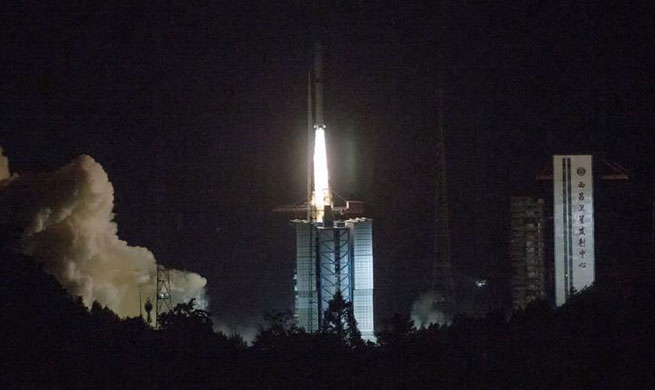
The relay satellite Queqiao, or Magpie Bridge, which was launched Monday, will fly to a halo orbit around the second Lagrangian point (L2) of the Earth-Moon system. It will be a communication link between controllers on Earth and the Chang'e-4 lunar probe, which is expected to soft-land on the far side of the Moon at the end of this year.
Chinese scientists will also conduct a laser-ranging test with the satellite at a maximum distance of 460,000 km, a record distance for an experiment of its kind, said Zhang Lihua, manager of the relay satellite project.
China has reportedly accomplished its first successful lunar laser-ranging, with a 1.2-meter telescope at southwest China's Yunnan Observatories on Jan. 22 this year, when scientists measured the distance between the Moon and the Earth, based on the signals of laser pulses reflected by the lunar retro-reflector planted by the U.S. Apollo mission more than 40 years ago.
Scientists calculated the time a laser pulse takes to travel from a ground station to the retro-reflector on the Moon and back again to get a measurement.
Just a few countries, including the United States, France and China, have successfully harnessed the lunar laser-ranging technology.
The Queqiao satellite, carrying a reflector developed by Sun Yat-sen University, is expected to extend laser-ranging to a new record distance.
As the satellite will fly at a constant high speed, it will be extremely hard for the laser beam from the ground to target the reflector on the satellite about 460,000 km away.
Luo Jun, an academician of the Chinese Academy of Sciences and president of Sun Yat-sen University, has proposed a space science program to detect gravitational waves. Laser-ranging is a necessary technology for that detection.