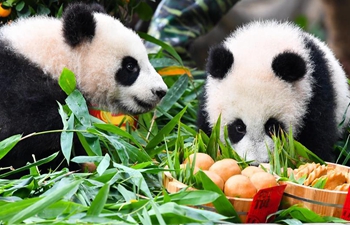
BEIJING, Feb. 1 (Xinhua) -- The "menu" for giant pandas 5,000 years ago might have been more diverse than today, when the black-and-white mammals lived in a wider range of environments, besides bamboo forest, according to new research.
The giant panda changed from omnivorous to vegetarian over its 8 million years of evolutionary history. It had been believed that giant pandas shifted to eating just bamboo about 2 million years ago.
But new research by a team of scientists with the Institute of Zoology of the Chinese Academy of Sciences (CAS) has found that giant pandas had not become specialized bamboo eaters until around 5,000 years ago.
"Giant pandas had become herbivores like deer at that time. But it's hard to know what specific plants they ate. We believe there were some herbs in addition to bamboo on their food list," said Wei Fuwen, an academician of CAS and the leader of the research team.
"Giant pandas today also eat herbs occasionally," he added.
Many large animals living in the same epoch as giant panda, such as stegodon, have become extinct. But the giant panda survived through millions of years, probably by constantly altering its diet to cope with the change in the environment, Wei said.
The research is based on a technology named stable isotope analysis. Nitrogen-15, a stable isotope of nitrogen, and carbon-13, a stable isotope of carbon, contained in food enters the body of animals and stays in their bones, teeth and hair. The analysis of stable isotopes in ancient animal fossils reveals their diets.
Researchers analyzed the carbon and nitrogen stable isotopes in bones belonging to giant pandas living 5,000 to 8,000 years ago, which were excavated from two sites in southwest China's Yunnan Province.
Then they continued such analysis on bone and tooth samples of ancient giant panda fossils from seven different sites across China, and found that the stable isotope value of ancient giant pandas was quite different from that of current giant pandas.
Giant pandas now survive in a fraction of their historical habitat. Wei's team found that the giant pandas 5,000 to 8,000 years ago lived in a more complicated environment including the warm and humid subtropical forest, as well as cold and dry regions.
The research was published online in academic journal Current Biology on Thursday.