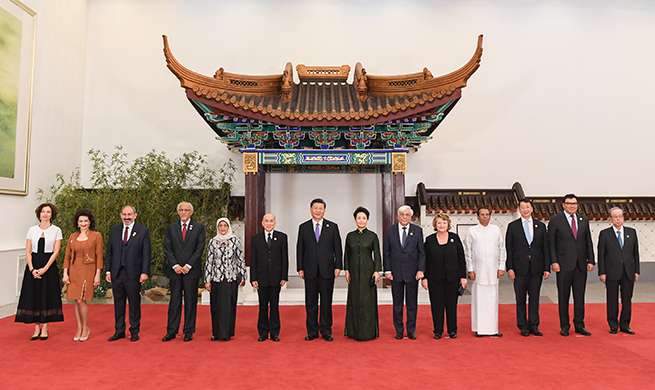
BEIJING, May 17 (Xinhua) -- Different civilizations should try to find common roots and focus more on what brings them together rather than what sets them apart, said Nada Al-Nashif, assistant director-general for Social and Human Sciences at UNESCO.
"If we focus on the positives of how we come together, we can overcome the fear, the distrust, and even the paranoia that sets in," Al-Nashif told Xinhua in an interview on the sidelines of the Conference on Dialogue of Asian Civilizations (CDAC) being held in Beijing.
Discrimination, racism or stereotyping, said Al-Nashif, are never the basic to human nature but were "things that we create."
"We have to be very careful to steer clear of those things," she added.
The CDAC, in Al-Nashif's eyes, manifested the convergence of values between China and the UNESCO, whose ongoing Silk Roads project is also committed to fostering a mutual understanding of diverse cultures.
"There is a lot of strength from culture diversity. This idea of how we interact, how we cross-fertilize each other, how we can learn, is very important to growth, to innovation, to how we can prosper as societies," she said.
Speaking of the ancient Chinese philosophy of "harmony without uniformity," Al-Nashif said people need to listen to all of the wise voices.
"We need more harmony, we need not just tolerance, we need empathy, more empathy, the thing of putting yourself in others' shoes, and understanding how we can be spiritually united is very important," she said.
As for China's role in exchanges of civilizations, Al-Nashif said China has been very helpful in supporting UNESCO's programs.
"This is a very strong partnership with China that has exhibited and reflected itself through the Silk Roads project for many, many years now ... To us, the value is really in trying to understand what mutually existence, what tolerance was about," said the official.
Al-Nashif recalled Chinese President Xi Jinping's speech at the UNESCO headquarters in Paris in 2014, and praised his vision that civilizations come in different colors, civilizations are equal and civilizations are inclusive.
"I think this has been a very big strength ..." she said. "This is not just about the past, it's very much about the future. And I think that was the spirit of the president's encouragement to us."
Al-Nashif said she was delighted that with China's support, the co-working on the UNESCO Interactive Atlas has covered all layers of the Silk Road via digital technology, which fulfills a very tangible collaboration.
"We have a lot to learn from China's very extensive history, from its geography, from the magic of this cultural sites, and all that they mean. There is no monopoly on wisdom in this day of age, I think we have to be open, and absolutely equal in understanding," she said.